

Nasal Valve Surgery
The nasal valve is a narrow passageway at the tip of the nose that regulates the air that enters the body as you inhale. Several common conditions, such as nasal trauma or fracture, congenital defects, and a deviated septum can cause the nasal valve to weaken and collapse inward, restricting or completely blocking airflow to the nose. The otolaryngologists at the Penn Medicine Becker ENT & Allergy Center offer minimally-invasive nasal valve surgery to correct this problem and help return your long-lost ability to breathe easily and do the activities you love the most.
Several studies have shown the significant negative impact of nasal obstruction on patient quality of life. Nasal obstruction can have several sources, and identifying the correct source in each patient is a critical component of providing effective treatment options. One site of anatomical nasal obstruction is the nasal valve which is discussed in more detail below.
What is the Anatomy and Function of the Nasal Valve?
The internal nasal valve – or “nasal valve” as it is commonly known – is a passageway in the front part of the nose through which air passes when we inhale. As the narrowest point of the nasal passage, the nasal valve is the primary site of airway resistance in the nose. Narrowing of this nasal valve area leads to decrease in the ability of air to pass freely into the nose. The nasal valve is bounded by the midline nasal septum, the inferior turbinate laterally, and the sidewall of the nostril to make a triangle-shaped space. This space is dynamic – the passageway can change when the turbinate swells, or the nasal sidewall collapses during inspiration. It is this “nasal valve collapse” which can cause some patients to complain of difficulty breathing through the nose, as it leads to blockage at the primary air-intake site of the nose.
Evaluation and medical treatment for nasal valve collapse
“Nasal valve collapse” refers to the inward collapse of the nasal sidewall during inspiration. This is easily recognized in the office when a patient is asked to inspire through their nose and this sidewall moves inward leading to blockage of nasal airflow. An Ear Nose and Throat physician will typically evaluate for nasal valve collapse both by external inspection and direct exam of the area – sometimes using a small nasal endoscope. In a “Cottle Maneuver” your physician may ask you to place lateral traction on your cheek area adjacent to the nose as you inspire. This will open the nasal passage and prevent the nasal sidewall to collapse. In a “Modified Cottle Maneuver” your physician will use a small probe placed inside your nose to stent open the nasal valve area while you inspire. Subjective improvement with either of these maneuvers suggests that strengthening your nasal valve may lead to enhanced nasal airflow. Alternatively, your physician may ask you to try some over-the-counter remedies such as “Breathe-rite strips” – designed to prevent nasal valve collapse while sleeping – in order to assess whether intervention for nasal valve collapse will provide sufficient improvement. As part of your examination, adjacent structures will also be evaluated – deviated septum and enlarged turbinates may lead to nasal obstruction as can nasal and sinus masses, polyps, and enlarged adenoids, all of which must be ruled out. Treatment options will be reviewed including medical and surgical treatments where appropriate. Proper diagnosis is key to effective treatment.
Candidacy for Nasal Valve Surgery
In some patients, medical treatments of surrounding structures may provide sufficient relief for patients who prefer to avoid surgical intervention. Taking down nasal swelling with topical nasal corticosteroids or oral anti-histamines, for instance, may work well enough for some patients with nasal obstruction. Others may find their symptoms bothersome only at night and will opt to wear an over-the-counter remedy such as “breathe-rite strips. Others, will choose to undergo surgical correction.
In many patients, the cartilage in the nasal valve area is weak or thin providing inadequate support, and leading to valve collapse. In most cases, this is simply related to a patient’s particular anatomy, while in others the weakness may be secondary to trauma or prior nasal surgery (ie-cosmetic rhinoplasty). It has been suggested that nasal valve collapse is more common than previously believed. One study evaluated 40 patients with persistent nasal obstruction despite prior septoplasty who went on to have surgery to correct nasal valve collapse. Patients reported significant reduction in nasal obstruction after a correction through nasal valve collapse surgery. However, the cost of the procedure can vary depending on the individual patient’s needs and the extent of the surgery. It is recommended to discuss nasal valve collapse surgery cost with your healthcare provider before undergoing the procedure.
-

- Real patient
Nasal Valve Surgery
Nasal valve surgery encompasses a variety of minor procedures designed to “stent” open the valve. Typically, a small piece of patient’s own cartilage is used for this procedure – either from the nasal septum, or from the cartilage of the ear. In some instances, an artificial graft is used; however, this is less commonly utilized than cartilage. One grafting technique – “alar batten grafts” – involve a small incision which is made on the inside of the nose for a “pocket” which is created for placement of the sculpted piece of cartilage. The cartilage is placed, inspected, and the pocket is closed. Healing is usually associated with minor discomfort, and most patients will experience improvement after a brief recovery period. There are other procedures that have also been designed to treat the nasal valve area. In many instances, “spreader grafts” (typically comprised of cartilage from the patient’s own nasal septum) will be sewn into a pocket adjacent to the septum as a means to open the valve. Others use a suture technique – “Flaring sutures” – to widen the angle of the nasal valve. Which specific technique is chosen varies by patient, and is based on a patient’s particular anatomy, surgeon preference, and other factors.
Latera Implant for Nasal Valve Collapse
Recent years have seen the rise of minimally-invasive office-based procedures for the treatment of isolated nasal valve collapse. One such procedure involves placement of the Latera nasal valve implant. The implant – which is FDA approved for treatment of nasal obstruction – is placed trans-cutaneously over the nasal valve area to support and stent open the lateral nasal wall and provide for an unimpeded nasal airway. The stent lasts for approximately 18 months during which time scar tissue is created to keep the valve area open after the implant absorbs and dissolves. In October, 2017 24-month data was presented from the first in-human study of the implant. Using the Nasal Obstruction Evaluation Survey (NOSE), patients were asked to rate their symptoms. Compared to pre-procedure survey results, 57.7 percent of patients reported significant NOSE score reduction at 24 months. After the Latera implant, patients report decreased nasal congestion and stuffiness, improved nasal airflow, less trouble sleeping.
Why Choose Our Specialists?
- Dr. Daniel G. Becker, Founder, and Medical Director of The Penn Medicine Becker ENT & Allergy Center, is a highly trained, board-certified specialist who graduated magna cum laude from Harvard College in 1986 and was awarded a full merit scholarship to attend the University of Virginia Medical School.
- Dr. Samuel S. Becker, Director of Rhinology at The Penn Medicine Becker ENT & Allergy Center, is a highly trained, board-certified specialist who graduated from Amherst College in 1991 and attended medical school at the University of California San Francisco.
- Dr. Kenneth Rosenstein is a highly trained, board-certified otolaryngologist who attended medical school at McGill University. Dr. Rosenstein specializes in ear, nose, and throat care, focusing on pediatric care, thyroid disease, hearing impairment, ear conditions, and voice and swallowing difficulties.
- Dr. Naomi Gregory is a highly trained, board certified otolaryngologist who specializes in the diagnosis and treatment of diseases of the ear, nose, and throat. Dr. Gregory completed medical school at the Philadelphia College of Osteopathic Medicine in Philadelphia PA.
- Dr. Michael Lupa, MD is a highly trained, board-certified otolaryngologist with additional training in sinus surgery and allergy treatment as well as advanced skull base surgery. He studied Biology at Tufts University and went on to complete medical school at Case Western University School of Medicine in Cleveland, Ohio.
- Dr. Robert Mignone is a highly trained, board-certified otolaryngologist-head and neck surgeon who attended medical school at New York College of Osteopathic Medicine.
- Dr. Aubrey McCullough is a highly trained otolaryngologist, facial plastic, and head and neck surgeon who completed medical school at Midwestern University Arizona College of Osteopathic Medicine.
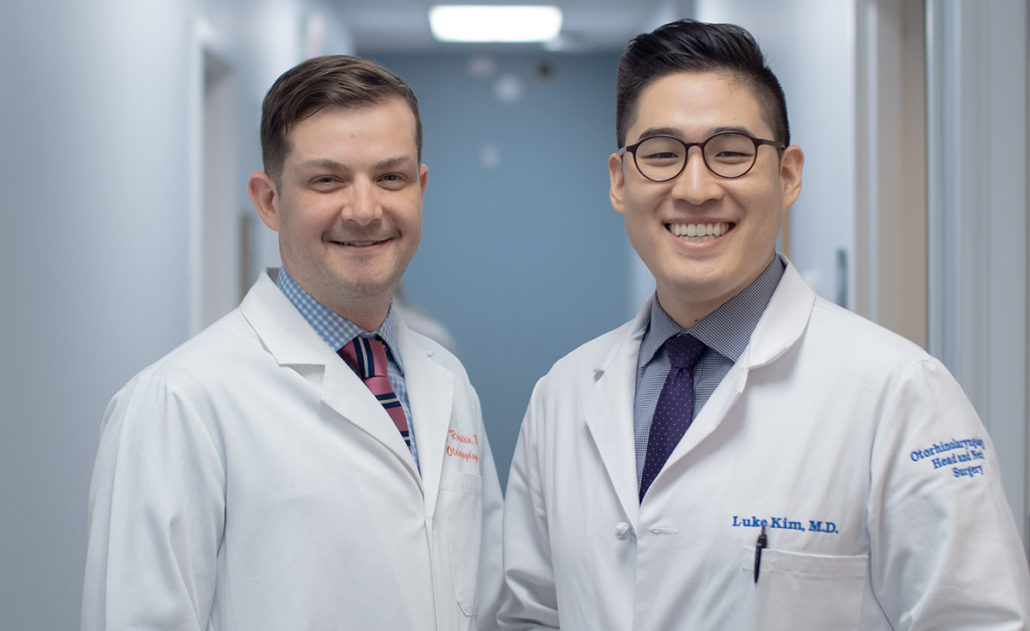
- Dr. Luke Kim is an otolaryngologist who specializes in the diagnosis, medical management, and surgical treatment of diseases of the ear, nose, and throat. Dr. Kim graduated with honors and with distinction from Cornell University and completed his medical studies at the Perelman School of Medicine at the University of Pennsylvania.
- Dr. Omar Ahmed is a highly skilled otolaryngologist-head and neck surgeon who completed his medical training at Rutgers Robert Wood Johnson Medical School. He is known for his extensive expertise in sinus and nasal disorders and has contributed significantly to the field with over 20 published articles and book chapters.
- Dr. Gileno Fonseca is a highly trained otolaryngologist-head and neck surgeon who attended medical school at the University of Florida. Since 2022, it has been board-certified in Otolaryngology.
- Dr. Alisa Yamasaki is a highly trained Otolaryngologist–Head & Neck Surgeon who completed her undergraduate studies at Dartmouth College and her medical degree at Harvard Medical School. She also completed a fellowship in Facial Plastic and Reconstructive Surgery at the University of Michigan Medical Center.
Additional procedures besides Nasal Valve Surgery
As noted above, the nasal valve is an area bounded by several structures. In some cases, addressing abnormalities in these surrounding structures may be recommended to ensure the creation of a widely patent nasal airway. When the nasal septum is deviated, correction may be recommended to remove blockage caused by the deviation. Similarly, patients may experience blockage due to enlargement of their inferior turbinates. These patients may benefit from reduction in size of the turbinates. There are many techniques for this, which are described in a separate section. When patients undergo nasal surgery to improve symptoms associated with nasal obstruction, surgeons may review a variety of procedures to address the varying components of the nasal obstruction. Recommendations will, of course, vary based on each patient’s anatomy, and symptoms.
-
- Real Patient
Nasal Valve FAQs
As noted above, there are several techniques available to address nasal valve collapse. Most nasal valve surgery is performed with the patient “asleep” under general anesthesia. In some cases – as with the Latera Nasal Valve Implant – the procedure may be performed in the office with the patient awake.
This depends on the technique used. Most nasal valve surgery does involve sutures to hold the implants in place. Often, these are absorbable sutures which do not require removal. More recently, the Lateral Nasal Valve Implant is designed for placement without stitches.
Nasal valve surgery may involve a slight change in the nasal appearance, typically centered around the nasal valve area. Changes depend on several factors including the specific surgical technique used, and should be discussed with your surgeon prior to surgery.
No. Nasal valve surgery does not typically involve packing.
-
- Real Patient
Nasal valve surgery is typically associated with minor discomfort that is well-controlled with over-the-counter medication such as Extra Strength Tylenol. Patient discomfort may vary based on individual factors, and on occasion, h3er pain medications (ie-Tylenol with Codeine) may be needed for a few days.
Surgical time varies based on technique used. The Latera Nasal Valve Implant, for instance, may be placed within a half-hour, while other techniques typically involve longer times which may vary based on any other procedures that are performed as part of the same operation. For example, in a patient undergoing an “open septoplasty”, the entire procedure might take up to 1.5 hours, but the nasal valve component of the procedure could last just 15-20 minutes. Details should be discussed with your surgeon.
In most cases, patients should plan to take a few days off from work. This can be highly variable, depending on the particular procedure performed, any adjunctive procedures, and the type and duration of anesthesia used. Details should be discussed with your surgeon.
If you live in the states of New Jersey or Pennsylvania, Penn Medicine Becker ENT & Allergy Center offers nasal valve surgery among its services. For a full list of services, please visit our Locations page.