

Penn Medicine Becker ENT
Penn Medicine Becker ENT & Allergy

  • Patient Forms
  • Reviews

Search

Instagram (opens in a new tab) YouTube (opens in a new tab)
  • Request an Appointment
  • Find a Doctor
  • Our Locations
    • Our Locations
    • View More Locations
    • Freehold Township, NJ
    • Princeton, NJ (Bunn Drive)
    • Hillsborough Township, NJ
    • Princeton, NJ (Ewing Street)
    • Lawrenceville, NJ
    • Robbinsville Township, NJ
    • Monroe Township, NJ
    • Sewell, NJ
    • Mount Laurel Township, NJ
    • Voorhees Township, NJ (East Evesham Rd)
    • Mullica Hill, NJ
    • Voorhees Township, NJ (Haddonfield-Berlind Rd)
    • Philadelphia, PA (South St)
    • Voorhees Township, NJ (Sheppard Rd)
    • Philadelphia, PA (Walnut St)
    • Woodbury, NJ
    • Plainsboro, NJ
    • Yardley, PA
  • Our Services
    • Our Services
    • Read Our Articles
    • Nose & Sinus
      • Urgent Care
      • Balloon Sinuplasty
      • Deviated Septum
      • Loss of Smell and Taste
      • Nasal Congestion and Blockage
      • Nasal Polyps
      • Nosebleeds
      • Post-Nasal Drip Treatment
      • Sinusitis
      • Sinus Pressure and Pain
      • Sinus Headaches
      • VivAer® and RhinAer® Treatments
      • Urgent Care for Sinus Infection
    • Ears
      • Comprehensive Ear Wax Buildup Care
      • Ear Infections
      • Eustachian Tube Dysfunction
      • Hearing Aids
      • Hearing Loss Treatment
      • Tinnitus Treatment
      • Urgent Care for Ear Infection
    • Sleep and Snoring
      • Central Disorders of Hypersomnolence
      • Circadian Rhythm Sleep-Wake Disorders
      • Insomnia Disorders
      • Oral Appliances
      • Parasomnias
      • Sleep Apnea Treatment
      • Sleep-Related Breathing Disorders
      • Sleep-Related Movement Disorders
      • Snoring & Sleep Treatment
      • Turbinate Reduction
    • Allergy
      • Allergic Asthma
      • Allergic Conjunctivitis
      • Allergic Contact Dermatitis
      • Allergic Rhinitis
      • Anaphylaxis
      • Angioedema
      • Drug Allergy
      • Food Allergy
      • Latex Allergies
      • Mold Allergies
      • Penicillin Allergy
      • Pet Allergy
      • Pollen Allergy
      • Seasonal Allergies
    • Throat
      • Swallowing Disorders Treatment
      • Voice Disorders
      • Gender-Affirming Voice Therapy
      • Tonsil Infections
      • Professional Voice Disorder
      • Stroboscopy
      • Voice Therapy
      • FEES
      • Chronic Cough
      • Laryngitis Treatment
      • Laryngopharyngeal Reflux
    • Head and Neck
      • Airway Problems
      • Dizziness & Vertigo Treatment
      • GERD
      • Neck and Branchial Cleft Cysts
      • Neck Masses
      • Salivary Gland Masses
      • Thyroid Disease
    • Pediatric
      • Pediatric ENT
      • Adenoid Hypertrophy
      • Tonsil and Adenoid Surgery
  • Patients Forms
  • Reviews
Woman peacefully sleeping in bed illustrating circadian rhythm sleep-wake disorders and natural sleep cycle disruption

Circadian Rhythm Sleep-Wake Disorders

The human body runs on an internal biological clock that governs nearly every physiological process — including when we feel alert, when we feel sleepy, and when we are primed for restorative rest. This clock, known as the circadian rhythm, operates on an approximately 24-hour cycle and is synchronized primarily by light and darkness. When it falls out of alignment with the external environment or with the demands of daily life, the result is a circadian rhythm sleep-wake disorder.

BOOK APPOINTMENT
Important Medical Notice

The information provided below and throughout this website is presented for general educational purposes only and does NOT constitute professional medical advice. This information is NOT a substitute for professional medical advice and NO material on this site is intended to be a substitute for professional medical advice. Always seek the guidance of your doctor or other qualified health professional with any questions you may have regarding a health or a medical condition. Never disregard the advice of a medical professional or delay in seeking it because of something you have read on this website.

At Penn Medicine Becker ENT & Allergy, our experienced ENT doctors recognize that patients with circadian rhythm disorders are not simply night owls or early risers by choice. These conditions reflect genuine biological misalignment that can make it extremely difficult to sleep and wake at socially expected times, regardless of how much effort a patient puts in. Many patients have struggled for years before realizing that the root cause of their sleep difficulties is not insomnia or poor sleep habits, but a disruption to their internal clock.

What Are Circadian Rhythm Sleep-Wake Disorders?

Circadian rhythm sleep-wake disorders are a category of conditions defined by a persistent misalignment between a patient’s internal biological clock and the sleep-wake schedule required by their environment, work, or social obligations. The sleep itself is not necessarily of poor quality — the problem is primarily one of timing. Patients often find that when they are allowed to sleep on their own schedule, they sleep relatively normally. The difficulty arises when external demands require them to sleep and wake at times that conflict with their internal clock.

These disorders vary in their cause and presentation, but they share a common thread: the body’s natural timing system is out of step with the world around it.

Types of Circadian Rhythm Sleep-Wake Disorders

Delayed Sleep Phase Disorder

Delayed Sleep Phase Disorder (DSPD) is one of the most common circadian rhythm conditions and is characterized by a significant shift of the sleep-wake cycle to a later time than is socially conventional. Patients with DSPD are often unable to fall asleep until the very early morning hours — typically between 2:00 AM and 6:00 AM — and will consequently struggle to wake for morning obligations. When allowed to sleep on their own schedule, they sleep and wake normally; the difficulty arises specifically in the context of conventional timing demands. DSPD is particularly common in adolescents and young adults and is sometimes informally referred to as the “night owl” pattern. Importantly, it is not simply a matter of staying up too late by choice — the delayed timing is biologically driven and does not shift easily with willpower alone.

Advanced Sleep Phase Disorder

Advanced Sleep Phase Disorder (ASPD) is essentially the opposite of DSPD. Patients experience a shift of the sleep-wake cycle to an earlier time than desired, becoming sleepy in the late afternoon or early evening — typically between 6:00 PM and 9:00 PM — and waking spontaneously in the very early morning hours, often between 2:00 AM and 5:00 AM. Sleep quality and duration may be entirely normal, but the timing creates significant social and professional challenges, as it is difficult to remain awake for typical evening activities. ASPD is more commonly seen in older adults.

Non-24-Hour Sleep-Wake Disorder

Non-24-Hour Sleep-Wake Disorder occurs when the circadian clock fails to synchronize properly to the 24-hour light-dark cycle, instead running on a slightly longer or shorter internal period. As a result, the sleep-wake schedule gradually drifts later or earlier each day, cycling through all hours of the clock over the course of weeks. This condition is most commonly seen in individuals who are totally blind, as light entering the eye is the primary external signal used to anchor the circadian clock to a 24-hour period. It can also occur in sighted individuals, though this is considerably less common. The disorder makes maintaining any consistent schedule extremely difficult.

Shift Work Disorder

Shift Work Disorder affects individuals whose work schedules require them to be awake and active during hours when the body is biologically programmed for sleep — typically overnight or in the very early morning. The resulting misalignment between the internal clock and the required activity schedule leads to difficulty sleeping when rest is possible, excessive sleepiness while working, and impaired functioning in daily life. Shift workers are also at increased risk for longer-term health consequences associated with chronic circadian disruption, including metabolic and cardiovascular effects.

Jet Lag Disorder

Jet lag occurs when rapid travel across multiple time zones temporarily places a person in an environment whose light-dark cycle is significantly out of step with their established circadian rhythm. Symptoms typically include difficulty sleeping at the destination’s local nighttime, daytime sleepiness, difficulty concentrating, and gastrointestinal disturbance. Most healthy individuals experience natural resolution within a few days as the body re-synchronizes to local cues. Jet lag becomes more clinically significant when travel is frequent, when crossing many time zones, or when the individual has an underlying vulnerability to circadian disruption.
Clinical Variables Measured During a Sleep Study

For circadian rhythm disorders, the evaluation often extends beyond a single overnight sleep study to include actigraphy — a wrist-worn device that tracks activity and rest patterns over multiple days or weeks — and sleep diaries. When a formal sleep study is conducted, the following variables are most relevant:

Sleep Architecture (N1, N2, N3, REM): The distribution of sleep stages across the night. In circadian rhythm disorders, sleep architecture is often normal when patients sleep on their preferred schedule but becomes disrupted when they are forced to sleep at biologically misaligned times.
Sleep Latency: The number of minutes it takes to fall asleep. Patients with DSPD, for example, will have markedly elevated sleep latency when attempting to sleep at a conventional time but normal latency when sleeping on their delayed schedule.
Arousal Index: The number of times per hour the brain briefly activates out of sleep. Reviewed to identify whether fragmented sleep is contributing to the patient’s daytime symptoms alongside the circadian misalignment.
Pulse Oximetry: Continuous monitoring of blood oxygen levels throughout the night to rule out a co-occurring sleep-disordered breathing condition.
Capnography: Measurement of CO2 levels during sleep to assess ventilation and exclude hypoventilation as a contributing factor to the patient’s symptoms.
Sleep Hygiene: Behavioral and environmental factors — particularly light exposure habits, screen use, caffeine timing, and schedule consistency — are especially relevant in circadian rhythm disorders, as they directly influence the timing signals the body receives.
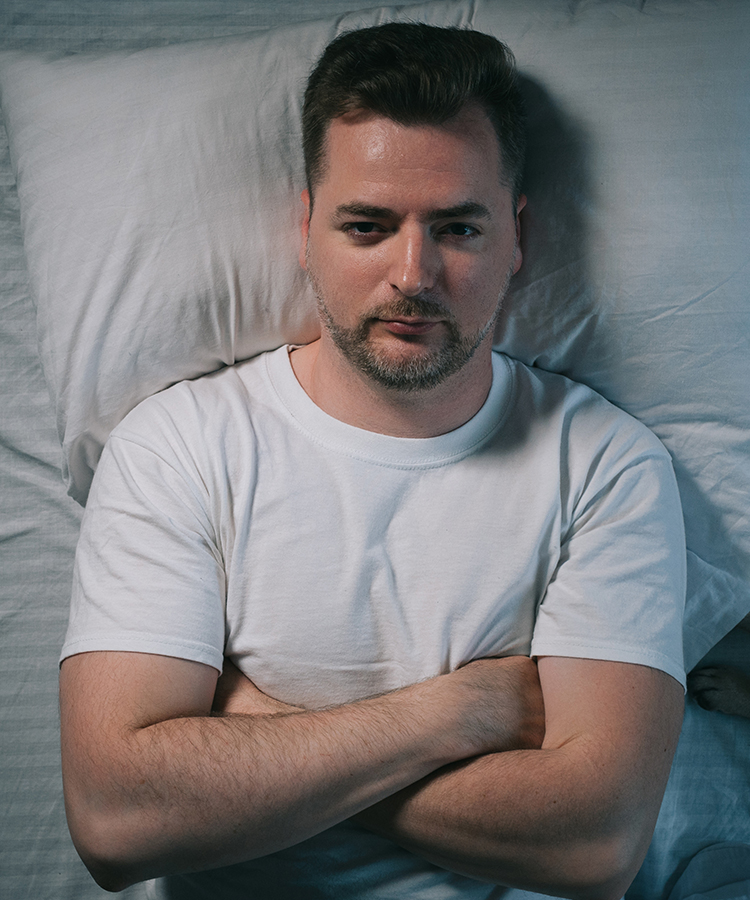
Man lying awake in bed at night, illustrating circadian rhythm misalignment and difficulty falling asleep

Patient Testimonials and Reviews

Read more reviews or leave your own to help others find expert ENT care.

The staff at Becker ENT made me feel comfortable because I was having a little anxiety before the appointment. The staff was very patient with me. My doctor was awesome, and he understood all my issues. Overall, I was satisfied with my care. Thank you so much.

  • Star full Star full Star full Star full Star full 5 stars

How the Circadian System Works

The circadian clock is regulated by a small region of the brain called the suprachiasmatic nucleus (SCN), which receives direct input from light-sensitive cells in the retina. Light exposure — particularly in the morning — helps synchronize the SCN to the 24-hour cycle. The SCN in turn regulates the release of melatonin from the pineal gland, which signals to the body that it is time to prepare for sleep. Disruptions to this system, whether from irregular light exposure, atypical schedules, or intrinsic biological differences in clock timing, can result in the misalignment that defines circadian rhythm disorders.

Understanding this mechanism is important for treatment. Most approaches to circadian rhythm disorders work by using light, darkness, and carefully timed melatonin to gradually shift the clock in the desired direction.
Background Locations

Pick one of our convenient locations
for Circadian Rhythm Sleep-Wake Disorder Treatment

Circadian Rhythm Sleep-Wake Disorders Frequently Asked Questions

How can I tell if I have Delayed Sleep Phase Disorder or just a bad sleep habit?

The key distinction is whether the delayed timing can be shifted voluntarily. Individuals with DSPD are unable to fall asleep earlier even when they genuinely try — the body simply will not allow it at that time. They may lie awake for hours attempting to fall asleep at a conventional time, yet sleep readily when their natural delayed schedule permits it. If your sleep is of good quality and normal duration when you sleep on your own schedule, but you consistently cannot fall asleep at conventional times despite genuine effort, DSPD may be a more accurate explanation than poor sleep habits.

Can circadian rhythm disorders be treated?

Yes. The most common approaches include strategically timed light therapy, careful management of light and darkness exposure throughout the day, melatonin supplementation taken at specific times, and gradual schedule adjustments. The most effective approach depends on the specific disorder and the patient’s lifestyle. Shift Work Disorder and jet lag are typically managed with a combination of light exposure strategies and sleep scheduling, while DSPD and ASPD may respond to more structured chronotherapy protocols.

Why do teenagers naturally stay up later?

Adolescence is associated with a genuine biological shift in the circadian clock toward later timing — a phenomenon well-documented in sleep research and distinct from social habits or screen use alone. This shift is driven by changes in the timing of melatonin release during adolescent development, making it physiologically difficult for most teenagers to fall asleep early and wake easily in the morning. Schools that have moved to later start times have observed meaningful improvements in student alertness and academic performance as a result.

Is melatonin safe to use for circadian rhythm disorders?

Low-dose melatonin taken at the appropriate time can be an effective tool for shifting circadian timing in conditions such as DSPD and jet lag. However, timing and dose both matter significantly — taking melatonin at the wrong time can produce the opposite of the intended effect. We recommend discussing melatonin use with a healthcare provider who can offer guidance based on your specific circadian pattern and goals, rather than self-directing supplementation.

Does Shift Work Disorder resolve when a person returns to a normal schedule?

For many people, symptoms of Shift Work Disorder improve when they transition to a more conventional schedule, as the body gradually re-synchronizes its clock to align with the new light-dark environment. However, the timeline for recovery varies, and some individuals find the adjustment more difficult than others. The longer-term health risks associated with shift work are primarily related to sustained misalignment over time, rather than any permanent change to the clock itself.

What circadian rhythm sleep-wake disorder treatment is near me?

If you live in New Jersey or Pennsylvania, Penn Medicine Becker ENT & Allergy offers evaluation and care for circadian rhythm sleep-wake disorders across multiple convenient locations. For a full list of offices, please visit our Locations page.

Book Your Consultation Today

Improve the quality of your life.

"*" indicates required fields

This field is for validation purposes and should be left unchanged.
By submitting this form I agree to the Terms of Use (opens in a new tab)

Background locations

Call now to schedule your appointment.

Appointments are available. Mon - Fri : 8 a.m. to 5 p.m.

COVID-19 Safety Updates

Freehold, NJ

732-375-9550

Hillsborough, NJ

908-271-2102

Lawrenceville, NJ

609-303-5163

Monroe, NJ

609-831-0779

Mt. Laurel, NJ

856-724-4031

Mullica Hill, NJ

856-478-3111

Philadelphia, PA (South St)

215-671-6330

Philadelphia, PA (Walnut St)

215-929-8301

Plainsboro, NJ

609-897-0203

Princeton, NJ

609-430-9200

Princeton, NJ

609-759-8500

Robbinsville, NJ

609-436-5740

Sewell, NJ

856-589-6673

Voorhees, NJ

856-565-2900

Voorhees, NJ (Haddonfield-Berlind Rd)

856-375-1440

Voorhees, NJ

856-772-1617

Woodbury, NJ

856-845-8300

Yardley, PA

267-399-4004

SEE ALL LOCATIONS
Penn Medicine Becker ENT & Sinus Surgery

Copyright © 2026. All Rights Reserved.
The Rhinoplasty Center (opens in a new tab) | Schrader Facial Plastic Surgery (opens in a new tab) | Rhinoplasty Archive (opens in a new tab) | Lozada Facial Plastic Surgery (opens in a new tab) | Becker Plastic Surgery (opens in a new tab) | Rejuvenation Resource (opens in a new tab) | Kam Facial Plastic Surgery(opens in a new tab) | Anni Wong MD Facial Plastic Surgery(opens in a new tab) | Yamasaki Facial Plastic Surgery(opens in a new tab) | David W. Allison, MD(opens in a new tab)
Terms . Privacy . HIPAA . Sitemap(opens in a new tab).

Instagram (opens in a new tab) YouTube (opens in a new tab)
Penn Medicine Becker ENT & Allergy

Call one of our locations now!

  • Freehold, NJ: (732) 375-9550
  • Hillsborough, NJ: (908) 271-2102
  • Lawrenceville, NJ: (609) 303-5163
  • Monroe, NJ: (609) 831-0779
  • Mt. Laurel, NJ: (856) 724-4031
  • Mullica Hill, NJ: (856) 478-3111
  • Philadelphia, PA: (215) 671-6330
  • Philadelphia, PA: (215) 929-8301
  • Plainsboro, NJ: (609) 681-6939
  • Princeton, NJ: (609) 759-8500
  • Princeton, NJ: (609) 430-9200
  • Robbinsville, NJ: (609) 436-5740
  • Sewell, NJ: (856) 589-6673
  • Voorhees, NJ: (856) 772-1617
  • Voorhees, NJ: (856) 565-2900
  • Yardley, PA: (267) 399-4004
  • Woodbury, NJ: (856) 845-8300